


Servo Motor Driver
Shandong Zkseasy Intelligent Technology Co., Ltd. is a technology enterprise focusing on the R&D, production and sales of micro servo motors, and is the servo production base of the National Robot Innovation Center.
The company adheres to the development concept of scientific and technological innovation and intelligent manufacturing, and its main business is divided into three major sectors, one is the R&D, production and sales of core components and products, that is, high-performance servo motors for robots; the second is the operation and service of industrial products, that is, the customer service of intelligent motors and motor industrial Internet platforms; The third is cultural robot services, that is, the R&D, production and application services of "Confucius" humanoid robots.
Why Choose Us
100% Satisfaction Guarantee
We're so confident you'll be happy with our services, we guarantee it.
Extensive Experience
Our team of professionals have been in the business for quite some time. Let us deliver solutions that work the first time!
Fair & Competitive Pricing
Our pricing structure is designed to make a modest profit so that we can continue to be a Hero another day.
-
![Ethercat Motor Driver]() Ethercat Motor DriverThe ethercat motor driver defined by Zkseasy is YKB200 and YKB300, which are specially developed to match miniature servo motors. With a size of only the palm of your hand, they are perfect for...read more
Ethercat Motor DriverThe ethercat motor driver defined by Zkseasy is YKB200 and YKB300, which are specially developed to match miniature servo motors. With a size of only the palm of your hand, they are perfect for...read more -
![Servo Motor Direct Drive]() Servo Motor Direct DriveThe absolute servo motor defined by Zkseasy is a micro motor integrated with an absolute encoder. Zkseasy absolute encoders are available in two types: single-turn absolute encoders and multi-turn...read more
Servo Motor Direct DriveThe absolute servo motor defined by Zkseasy is a micro motor integrated with an absolute encoder. Zkseasy absolute encoders are available in two types: single-turn absolute encoders and multi-turn...read more


Precision: Servo motor drivers provide unparalleled precision in controlling motor performance, making them ideal for tasks demanding accurate positioning and motion control.
Speed and Responsiveness: They can quickly adapt to changing load conditions and adjust motor speed and torque accordingly, ensuring efficient and responsive operation.
Energy Efficiency: Servo motor drivers maximize energy efficiency by delivering only the required power to the motor, minimizing waste and reducing operating costs.
Reduced Maintenance: Precise control and efficient operation result in reduced wear and tear on motors and machinery, leading to extended equipment life and reduced maintenance requirements.
Versatility: Servo motor drivers are versatile and compatible with various types of servo motors, making them suitable for a wide range of applications.
What Is Servo Motor Driver
A servo drive receives a command signal from a control system, amplifies the signal, and transmits electric current to a servo motor in order to produce motion proportional to the command signal. Typically, the command signal represents a desired velocity, but can also represent a desired torque or position.
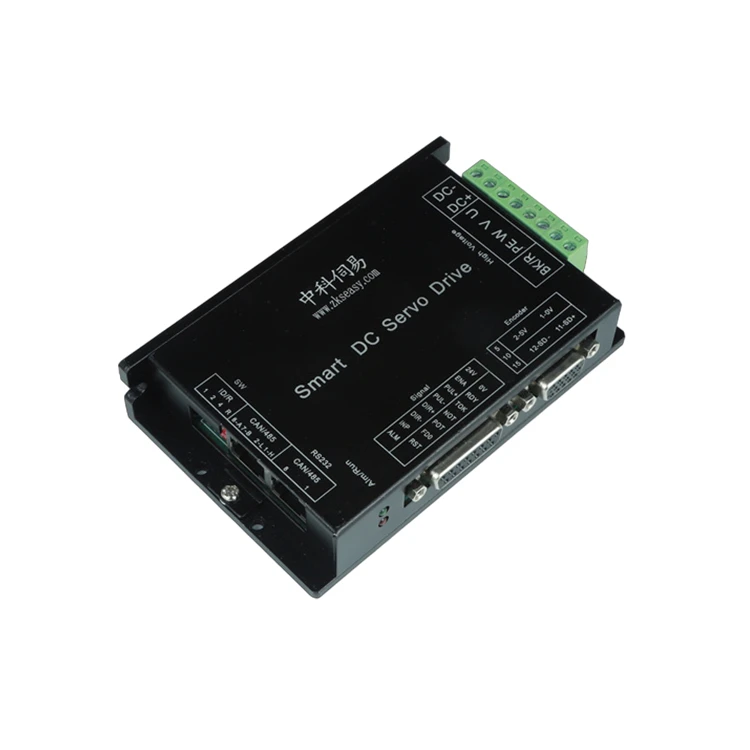
A motor servo motor driver is a device that helps control and operate a servo motor. It takes input signals and converts them into the right kind of motion and torque so that the motor can perform its specific task. Different types of servo motor drivers are available on the market, each with unique features and benefits.
When choosing a servo motor driver, these are some factors to consider to ensure you get the best one for your needs.
Power rating
The power rating of a servo motor driver indicates the maximum amount of power it can handle. Choosing a servo motor driver with a power rating that’s compatible with the servo motor you are using is important. If the power rating is too low, the servo motor driver will not be able to provide enough power to operate the servo motor properly. If the power rating is too high, you will be wasting money on a servo motor driver that can handle more power than you need.
Voltage requirements
The voltage requirements of a servo motor driver must match those of the servo motor. Using a servo motor driver with a different voltage than the servo motor can damage the servo motor driver and servo motor. Not all servo motor drivers operate on the same voltage, so make sure to check the specifications of both the servo motor driver and servo motor before making a purchase.
Current rating
The current rating of a servo motor driver is the maximum amount of current it can provide. The higher the current rating, the more powerful the servo motor driver will be. Choosing a servo motor driver with a current rating that is too low can cause the servo motor to stall or run slowly.
Speed rating
The speed rating of a servo motor driver is the maximum speed at which it can operate. Choosing a servo motor driver with a speed rating that is too low can cause the servo motor to run slowly. Choosing a servo motor driver with a speed rating that is too high can cause the servo motor to overheat and fail.
Efficiency
The efficiency of a CNC servo motor driver indicates how much power it uses compared to the amount of power it provides. The higher the efficiency, the less power the servo motor driver will use. Choosing a high-efficiency servo motor driver can help save money on your energy bill.
The operation of a servo motor driver involves several key components and processes:
Control Input: The servo motor driver receives control signals from the system or operator. These signals specify the desired position, speed, and torque for the motor.
Feedback System: A critical element in servo motor driver operation is feedback. This can be achieved through various devices such as encoders or resolvers, which continuously provide information about the motor’s actual position and speed.
Comparison: The servo motor driver constantly compares the desired motor performance, as specified in the control signals, with the real-time feedback data.
Error Signal: Any discrepancy between the desired and actual performance generates an error signal, which is used to adjust the motor’s operation.
Amplification and Control: The servo motor driver amplifies the error signal and generates a control signal that modulates the motor’s power supply. This ensures that the motor moves in a manner that minimizes the error, bringing it closer to the desired performance.
Closed-Loop Control: Servo drives operate in a closed-loop control system, meaning they continuously monitor and adjust the motor’s performance based on feedback. This allows them to maintain precise control over position, speed, and torque.

Why You Should Use a Servo Motor Driver?
The utilization of servo motor drivers offers several compelling reasons, including:
Precision Control
Servo drives excel at precise control of motor performance, ensuring accurate positioning, speed, and torque.
01
Speed and Efficiency
They enable rapid acceleration and deceleration, enhancing operational speed and efficiency.
02
Dynamic Response
Servo drives can quickly respond to changing load conditions and adjust motor performance accordingly.
03
Reduced Heat Generation
Efficient operation results in lower heat generation, contributing to extended motor and drive lifespan.
04
Energy Savings
Precise control and reduced heat generation lead to energy savings, making servo motor drivers a cost-effective choice.
05
Voltage requirements
When selecting a Servo Drive, it must match the voltage requirements of the servo motor. If the voltage of the drive is not matched to the servo motor, damage to the servo motor driver and servo motor may result.
Power Requirements
The power of the servo motor driver represents the maximum power it can control the servo. If the power of the servo controller is too low, below the power of your servo motor application, it will not be able to control the servo motor properly. If the power of the servo motor driver is too high, higher than the power required by your servo motor application, it will cause unnecessary waste of money.
Speed requirement
The speed of the servo motor driver is also an important factor to consider when you make your selection. Using a drive with a speed that is too low to control the servo motor will cause the motor to run too slowly and affect the efficiency of the application. Therefore choosing the right speed is important for servo controllers.
Feedback device
The choice of feedback device is critical to the performance of a servo system. The servo motor driver must be compatible with the feedback mechanism, whether it is an encoder, resolver or other sensor type, to ensure precise control of the motor. The resolution and accuracy of the feedback device directly affect the accuracy of the system.
Servo motor driver generally has three control methods: position control mode, torque control mode and speed control method.
The position control mode can determine the rotational speed generally through the external input pulse frequency and the rotation angle by the number of pulses. Some servo systems can assign velocity and displacement directly by means of communication. Because the position mode can control the speed and position strictly, it is generally used in the positioning device.
Torque control mode is assigned by the external analog input or direct address to set the external output torque of motor shaft. The torque can be changed by changing the setting of the analog immediately and the corresponding address value can be realized by the change of communication mode. The main application has strict requirement for the material on stress in the winding and unwinding device, such as winding device or fiber optic equipment. The setting of the torque should be changed at any time according to the radius of the winding so as to ensure that the force of the material does not change with the change of the winding radius.
Speed mode can have control for the rotation speed through the input of the analog quantity or the pulse frequency. The outer loop PID with the upper control device can be positioned. But the position signal of the motor or the position signal of the direct load should be sent to the upper feedback for calculation. The position mode also supports direct load loop detection position signal. At this moment, the coder at the motor shaft end can only detect the motor speed and the position signal is provided by the detection device directly of the final load end. The advantage of this method is that it can reduce the error in the intermediate transmission process and increase the positioning accuracy in the whole system.
How Does a Servo Motor Driver Work?
The servo motor driverr adopts digital signal processor (DSP) as the control core, an realize the complex control algorithm, digitization, networking and intelligentialization. The power device generally adopts intelligent power module (IPM) as the driving circuit of the core design. IPM integrated drive circuit with over-voltage and over-current, overheating, undervoltage fault detection and protection circuit. The soft start circuit is also added in the major loop, so as to reduce the impact on thedrive in the start-up process.
First, the power drive unit is rectified by the three-phase full bridge rectifier circuit to input the three-phase electric or municipal power, and the corresponding DC power is obtained. The three-phase power or electric supply after rectifying can drive the AC servo motor through three-phase sine PWM voltage source inverter frequency conversion. The whole process of the power drive unit can be simply described as the process of AC-DC-AC. The main topology of the rectifier unit (AC-DC) is the three-phase full bridge uncontrolled rectifier circuit.
Our Factory
The company has the most complete servo motor testing and experimental equipment in China, including comprehensive tester, waterproof test chamber, dustproof test chamber, salt spray test chamber, high and low temperature test chamber and vibration test bench, etc., and has been rated as the key laboratory of micro servo motor city, which can provide testing and experimental services to the outside world.


FAQ
Q: What is a Servo Drive?
The power section consists of a mains rectifier, a DC-bus, and a power circuit which supplies the individual motor phases with current.
The control loops (analog or digital) drive the power circuit and by constantly comparing setpoint with actual values ensure that the motor keeps exactly to the desired motions even under varying load.
In addition, ESR servo drives offer a broad spectrum of functionality (see drive tasks).
Q: How to Choose the Appropriate Servo Drive?
Is the servo drive going to be used in velocity mode in a multi-axis application with a higher-level controller (e. g. CNC)? Then an analog servo drive may be sufficient.
Q: How to Choose the Appropriate Servo Motor?
Q: How do I choose a servo motor and drive?
While most of the electrical drive systems are operated at constant speed, a servo drive has a rather "hectic" life. Often it has to accelerate to the rated speed within a few milliseconds only to decelerate a short time later just as quick. And of course the target position is to be reached exactly with an error of a few hundredths of a millimeter.
Compared to other controlled drives servo drive systems have the advantage of high dynamics and accuracy, full stall torque, and compact motors with high power density.
Q: Where are Servo Drive Systems Used?
Servo drives systems run in large, highly automated installations with several dozens of axes as well as in machines with only a few axes which perhaps operate independently. Further information on servo drive systems and their usage can be found at drive tasks.
Q: What is the driver of a servo motor?
Q: Do you need a motor driver for a servo motor?
Q: What drives a servo motor?
A device that is a structural unit of a servo system and is used with a servomotor. The servo drive controls the servomotor according to instructions from a PLC or other controller and performs feedback control with signals from an encoder or other component.
Q: Which drive is used for servo motor?
Q: What motor driver should I use?
Q: How do you control a servo driver?
Q: What is the difference between servo motor driver and stepper motor driver?
Q: What is the main function of the servo drive?
Q: What is the difference between a servo drive and a servo motor?
Q: How do I choose a motor driver for my motor?
Once the type of motor is established, attention must be given to certain key parameters related to that motor, including: Output current. Application voltage (3.3/5, 12, 24/36, 250, 600 V) Rated power dissipation.
Q: Do all stepper motors need a driver?
Q: Do you need a servo driver?
Q: How do you size a motor driver?
Q: How to control motor without motor driver?
Q: Do you need motor driver for DC motor?
We're well-known as one of the leading servo motor driver manufacturers and suppliers in China. If you're going to buy high quality servo motor driver at low price, welcome to get pricelist from our factory. Also, customized service is available.
servo motor heavy duty parts, servo motor driver for servo motors with x power down protection capabilities, servo motor driver for packaging